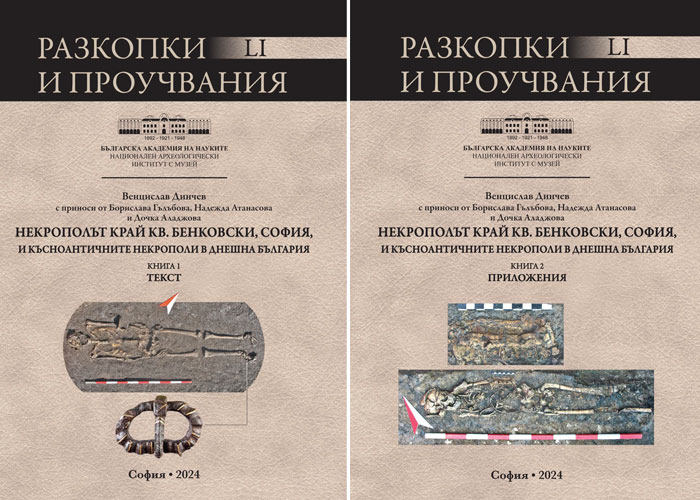
Некрополът край кв. Бенковски, София, и късноантичните некрополи в днешна България. Книга 1. Текст; Книга 2. Приложения
The necropolis at the Benkovski quarter of Sofia and the late antique necropoleis in present day Bulgaria. Book 1. Text; Book 2. Appendice
Abstract
This study combines the goals and methodology of a publication about a particular necropolis with those of a general study of late antique necropolises in the territory of present-day Bulgaria.
The archaeological site with the necropolis studied in 2015 is near the Benkovski district of Sofia, with a central location in the Sofia plain. The necropolis was partly dug into an earlier mound that has not survived today. Late Antique graves dug into earlier mounds have been studied in many places in Southern Bulgaria.
The location of the graves at the Benkovski necropolis – a total of 72 examined – evidences a spatial distinction by family affiliation. Information about distinction in the “world of the dead” during Late Antiquity usually implies a distinction by family affiliation.
Among the features of the Benkovski necropolis are the so-called ground markings – rectangular or oval stone enclosures. They are associated with the deeper graves. However, they are high above the graves and their vertical projections in depth do not outline the buried, but only partially overlap them. They are later than the real graves and are an expression of commemorative customs. So far, such facilities are rare exceptions among the studied necropolises.
Only for some burial pits in the Benkovski necropolis is there evidence of wooden structures, permanent covering or other additional layout. All variants have parallels among the known late antique necropolises.
Those buried in the Benkovski necropolis are individuals of both sexes and of different age groups. With one exception, the orientation of the buried individuals is according to the Christian rite. However, some interesting features of the rite have been registered – for example, the strong tightening of the chest, found in 18 individuals of both sexes, laid in deeper grave pits. The secondary opening of a significant number of graves and the displacement of bones of the individuals laid in them have also been registered. The tightening of the chest is a practice known so far only in a few necropolises in Western Bulgaria. Secondary intervention and the purposeful displacement of bone remains in graves have been found in more late antique necropolises throughout present-day Bulgaria. In the Benkovski necropolis, “protective” ritual practices derived from the use of fire have also been registered, but only with single examples.
Only in 12 graves of the Benkovski necropolis was any inventory found. Data from about 150 necropolises prove a definite trend towards a decrease in grave inventory availability during Late Antiquity.
Coins were found in two graves of the Benkovski necropolis – 2 pcs. in one and 6 pcs. in the other. The earliest coin was minted in 308 – 310, and the latest are from the second quarter of the 5th century. Among the remaining inventory, earrings and buckles are better represented. Two combs are also present. The necropolis functioned at the end of the 4th – first half of the 5th century. Given the results of radiocarbon dating of samples from several graves, it is not entirely excluded that individual burials have a later date.
The Benkovski necropolis belongs to a late antique provincial population, probably of Thracian and/or Sarmato-Alan origin. I accept the option with “and” (instead of “or”) as more likely, i.e. I am inclined to assume that this necropolis was used by an ethnically heterogeneous population. It can also be assumed that its users were people of relatively low social status, engaged in agrarian production.