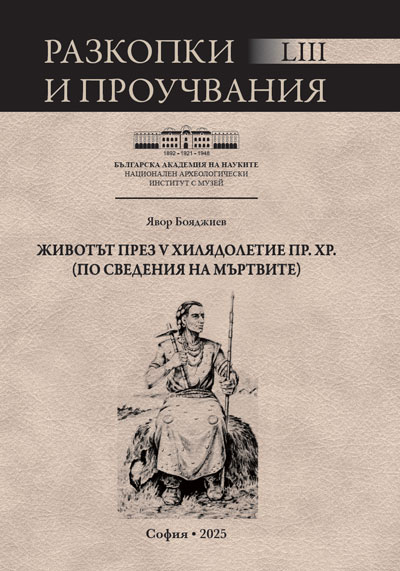
Животът през V хилядолетие пр. Хр. (по сведения на мъртвите)
Life in 5th millenium BC (based on information from the dead)
Abstract
The book presents more than 40 years of author's studies on Chalcolithic cemeteries (5th millennium BC) in present-day Bulgaria including archaeological excavations, field records, studies and preparation for publication. The author participated in the excavations at Durankulak and Varna I – two of the most famous and largest Chalcolithic cemeteries. The accumulated experience allows the definition of possible deviations from the real information during the different research stages – from the archaeological excavations to the final publication. Respectively, this distorted information is subsequently used by various scholars to validate different hypotheses and suggestions. The maximum accurate reconstruction of the background data provides grounds for the correction of a number of concepts and suggestions that emerged as a result of the discovery of the Varna I Chalcolithic cemetery and the stunning rich burials unearthed in the early years of its excavation, when there was not enough information about the entire situation and the complete picture of the burial rituals in the Chalcolithic on the territory of present-day Bulgaria.
The main aim of the work is to assess to what extent the excavated remains allow the reconstruction of the burial ritual of the various ethnic and cultural Chalcolithic communities and how accurately they reflect the actual situation in the 5th millennium BC. This information can contribute to the knowledge of the life of the people 6000 – 7000 years ago based on the excavated burials.
The book presents the available information about burials yielded by 26 cemeteries until present on the territory of present-day Bulgaria and a detailed study on the elements of the burial ritual in each of them: location, burial facilities, burial position and orientation of the skeleton, composition and location of the grave goods. Attention is paid to deviations from burial ritual typical for the particular cemetery. The development of the individual elements of the funerary rite in the Durankulak cemetery is examined. A detailed analysis of the funerary rite in the Varna I cemetery is presented based on all burials studied up to 2020. Human remains in eight settlements were also analysed. They are particularly numerous in Tell Ruse and Tell Yunatsite. They are particularly numerous at Tell Ruse and Tell Yunatsite, in each of which over 100 individuals have been excavated.
The available 14C dates for six cemeteries and two settlements are presented. The series from the Varna cemetery and Tell Yunatsite clearly show the problems regarding radiocarbon dating of the Chalcolithic period on the territory of Bulgaria.
Separate chapters are dedicated to:
• The population – ethno-cultural situation and processes in the 5th millennium BC;
• The people – physical characteristics, clothes and personal adornments, “fashion” trends;
• The family;
• The society – its structure, economic development of the communities in the Late Chalcolithic, social development and spiritual life;
• The end of the Chalcolithic population.